
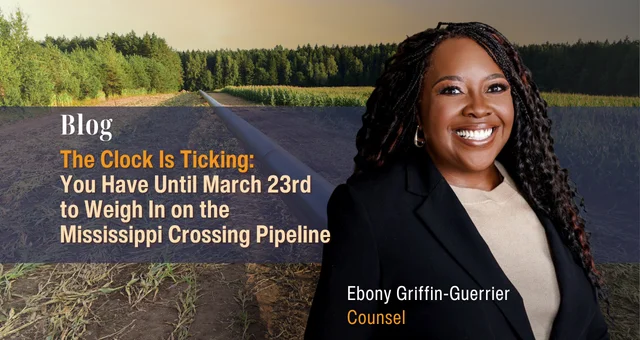
The Clock Is Ticking: You Have Until March 23rd to Weigh In on the Mississippi Crossing Pipeline
This is the second in our series on the Mississippi Crossing Pipeline (MSX). If you're new here, catch up with our first post [link], which covers the basics of the project and what it means for landowners along the route.
Last summer, we discussed the Mississippi Crossing Pipeline — a nearly 208-mile natural gas pipeline proposed by Kinder Morgan’s Tennessee Gas Pipeline Company that would run from Greenville, Mississippi to Butler, Alabama. At that point, the focus was on a critical legal deadline to preserve your rights to challenge the project. Many of you responded, and we’re grateful for the engagement.
Now there's a new deadline you need to know about, and it's just around the corner: March 23, 2026. And this time, the deadline matters for an even wider group of communities than we initially realized.
What's Happening Right Now
Federal regulators at the Federal Energy Regulatory Commission — FERC for short — are the ones who decide whether these pipelines get built. Before they make that decision, they’re required by law to study the projects’ potential environmental effects and share those findings with the public. That study is called an Environmental Impact Statement, or EIS.
Here’s something important: FERC is reviewing the Mississippi Crossing Pipeline together with a second, related project called the South System Expansion 4 — or SSE4 — under a single combined environmental study. Both projects are proposed by Kinder Morgan subsidiaries, and both are moving through the approval process on the same timeline. FERC released a draft version of that combined study on January 30, 2026, and is now accepting public comments on both projects through March 23rd. This is one of the most meaningful opportunities you will have to put your concerns on the record before a final decision is made on either project.
What Are These Two Projects?
The Mississippi Crossing Pipeline (MSX) is a brand new pipeline — approximately 208 miles of it — running from Greenville, Mississippi through ten Mississippi counties and terminating in Choctaw County, Alabama. It would be built and operated by Tennessee Gas Pipeline Company, a Kinder Morgan subsidiary.
The South System Expansion 4 (SSE4) is a separate but connected project proposed by Southern Natural Gas Company and Elba Express Company, also Kinder Morgan-affiliated. Rather than an entirely new pipeline, SSE4 would add new pipeline loops running largely alongside Southern Natural Gas’s existing South Main Line — approximately 291 miles of additions stretching across Mississippi, through ten Alabama counties, and into Georgia. The Alabama counties in SSE4’s path are Sumter, Marengo, Hale, Perry, Dallas, Autauga, Elmore, Tallapoosa, Macon, and Lee. The project would also involve upgrades and expansions at existing compressor stations across the region.
The two projects connect in Choctaw County, Alabama, and together are designed to significantly increase the flow of natural gas into the Southeast.
What the Draft EIS Found
The draft EIS is a lengthy technical document, so here's what you need to know in plain terms.
For the MSX, construction would cross more than 1,000 bodies of water, including the Big Black River and the Natchez Trace Parkway, affecting approximately 146 acres of wetlands. Three new compressor stations would be built in Humphreys, Attala, and Lauderdale counties in Mississippi.
For the SSE4, construction would affect approximately 224 acres of wetlands and cross the Flint, Oconee, and Tallapoosa Rivers, among others. Compressor station upgrades are planned at multiple existing sites across Mississippi, Alabama, and Georgia.
For both projects, FERC’s staff concluded that with the companies’ proposed mitigation measures in place, environmental effects would be “less than significant.” Many people along both routes see things differently — and that’s exactly what the public comment process is for.
Something Worth Knowing
Since our last post, new information has come to light about who these pipelines are actually being built to serve. Reports indicate that a significant portion of the capacity is intended to supply power to data centers — the large facilities that run the internet, cloud computing, and artificial intelligence systems. We’re sharing this because it’s information that may be relevant to how you think about these projects and whether you want to weigh in.
Your Voice Matters — Here's How to Use It
FERC is a federal agency, and it hears from industry and pipeline companies constantly. Public comments from real people — especially people who live along the route — carry genuine weight. You do not need to be a lawyer or an expert to submit one. You just need to speak from your own experience and perspective.
What Does a Public Comment Look Like?
A public comment doesn’t have to be long or formal. It can be a few paragraphs. It should identify who you are and your connection to the project — whether you own land along the route, live nearby, farm the land, hunt on it, or simply care about your community. From there, you say what’s on your mind.
You can submit your comment electronically through FERC’s eComment system at ferc.gov, or by mail addressed to: Debbie-Anne A. Reese, Secretary, Federal Energy Regulatory Commission, 888 First Street NE, Room 1A, Washington, DC 20426. If your comment relates to the Mississippi Crossing Pipeline, reference docket number CP25-514-000. If it relates to the South System Expansion 4, reference docket number CP25-517-000. If both projects affect you, you can reference both numbers in a single comment.
Things to Think About as You Draft Your Comment
There's no formula for a good comment, but here are some questions that might help you figure out what you want to say:
- What does this land mean to you? Have you farmed it, hunted it, or passed it down through your family? The personal and economic value of your property is relevant — and it's something you know better than any federal agency.
- What do you know about the land's relationship to water? If your property sits near a creek, river, wetland, or flood-prone area, share that. FERC's staff reviewed maps and data, but you've lived there.
- Have you already been contacted by the company? If a right-of-way agent has approached you, or if you've felt pressured to sign anything, that context is worth sharing.
- What concerns do you have about the compressor stations? Three new stations will be built in Humphreys, Attala, and Lauderdale counties, Mississippi. If you live near one of those sites, air quality, noise, and safety are all fair topics to raise.
- Do you feel the environmental review accounted for your community? If you think the draft EIS underestimated impacts on your neighborhood, farm, water supply, or way of life, say so specifically.
- What alternatives would you like to see considered? You can ask FERC to require the company to look at different routes, additional protections, or alternative approaches.
The Deadline Is March 23rd — Don't Wait
Once the comment period closes, FERC will finalize the EIS and move toward a decision on both projects. Comments submitted before the deadline become part of the official record and must be considered. Comments submitted after do not. Whether you’re in the Mississippi counties along the MSX route, the Alabama counties in SSE4’s path, or anywhere else these projects touch your life — now is the time to say something.
 Counsel
Ebony H. Griffin-Guerrier is Counsel at Singleton Schreiber LLP and Co-Director of the firm's Impact Litigation & Policy group, where she leads legal strategy, policy advocacy, and community engagement across a broad range of ...
