
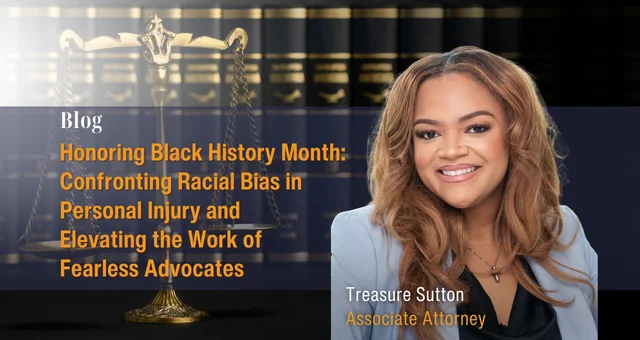
Honoring Black History Month: Confronting Racial Bias in Personal Injury and Elevating the Work of Fearless Advocates
Black History Month is a time to honor the resilience, brilliance, and hard-fought progress of Black Americans—and to reckon with the inequities that persist. Historically in personal injury cases, racial bias compounds harm, suppresses settlement value, and obstructs recovery for Black Americans and other people of color. As Black women trial lawyers, we stand on the shoulders of the fearless advocates who have confronted these inequities with clarity, courage, and conviction.
Racial bias shows up from the moment of injury through verdict and recovery. It is not theoretical. It is the daily lived experience of Black clients seeking justice in systems too often designed without them in mind.
Black plaintiffs too often receive settlement offers that reflect biased assessments of pain, suffering, and future losses. Hidden assumptions about credibility, “value,” and life expectancy quietly depress numbers. When defense models rely on historical data tainted by discrimination, a fair evaluation for a person of color is difficult to achieve. We take into account the fullness of a client and refuse to accept a devaluation disguised as “standard practice.” We demand individualized assessments grounded in the full human story, which includes expert-supported damages, and rigorous economic analyses that do not discount Black lives.
Bias in Medical Treatment and Documentation
Medical records control case value, but bias in care yields bias in recovery. Black patients are more likely to have their pain underassessed, and their symptoms minimized. Documentation gaps give insurers leverage to challenge causation or necessity of treatment. We insist on prompt, culturally responsive care; we help clients navigate provider networks; and we work to ensure the record accurately reflects lived pain, functional limits, and the trajectory of relief
Research indicates that implicit racial biases affect perceptions of pain tolerance, often resulting in the erroneous assumption that Black individuals experience less pain or endure pain better than others. Studies reveal unconscious racial bias influences medical treatment decisions, with Black patients, particularly Black women, who are deemed less likely to receive aggressive pain management compared to white patients, even when presenting identical symptoms.
Systemic Barriers to Justice
Unfortunately, systemic obstacles do not end at the clinic door. Transportation deserts, job inflexibility, childcare burdens, and insurance denials can impede consistent treatment. Credit and housing disparities magnify financial stress during recovery. We counter these barriers by coordinating care pathways, seeking accommodations, and building records that make systemic context visible to mediators, adjusters, judges, and juries.
These are patterns, not isolated events. At Singleton Schreiber, we situate individual harm within the contextual landscape so decision-makers understand how cumulative risk leads to compounded loss.
Our Commitment:
Our clients are not statistics; they are parents, caregivers, workers, children, students, and leaders whose lives deserve to be valued in full.
During Black History Month, and every month, on both sides of the ‘V’ we must center dignity, agency, and healing in every evaluation. Justice is not charity; it is duty.
For those seeking counsel that meets courage with competence, and strategy with heart, Singleton Schreiber is here.
 Associate Attorney
Treasure Sutton, Associate Attorney
Treasure Sutton is an Associate Attorney at Singleton Schreiber, based in the firm’s Birmingham office. Her practice focuses on personal injury and premises liability, where she draws on a ...
