
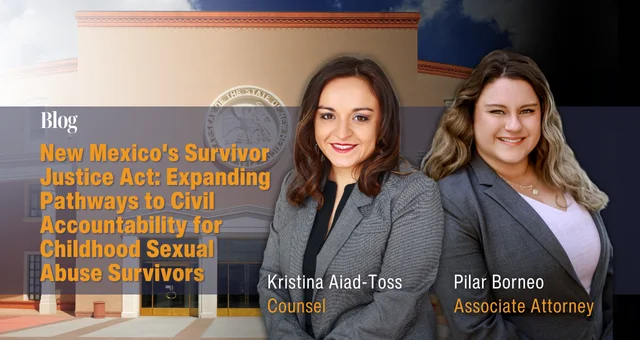
New Mexico's Survivor Justice Act: Expanding Pathways to Civil Accountability for Childhood Sexual Abuse Survivors
By: Kristina Aiad-Toss and Pilar Borneo
Childhood sexual abuse is one of the most devastating experiences a person can endure, leaving scars that can last a lifetime. For many survivors, the path to healing involves not only personal recovery but also seeking justice and accountability from those who enabled or ignored the abuse. Yet for decades, survivors in New Mexico and across the country have faced an impossible obstacle: statutes of limitations that expired long before they were emotionally or psychologically ready to come forward.
New Mexico is now poised to take a significant step toward changing that reality. Representative Marianna Anaya has introduced the Survivor Justice Act (House Bill 69) during the 2026 Regular Session, legislation that would dramatically expand the civil timeline for survivors of childhood sexual abuse to file lawsuits. If enacted, this bill would represent one of the most meaningful expansions of civil accountability for childhood sexual abuse in New Mexico's history.
Why Civil Statutes of Limitations Matter
Research consistently shows that survivors of childhood sexual abuse often delay disclosure for decades. Trauma, grooming, fear, shame, and power dynamics all contribute to what experts recognize as delayed disclosure, a well-documented phenomenon supported by extensive psychological and medical research. Studies frequently cite the average age of disclosure as approximately 52 years old, meaning that many survivors don't fully process or speak about their abuse until middle age. Many also don’t even recognize they are survivors.
Short civil deadlines effectively prevent survivors from ever seeking justice or accountability. While criminal prosecution is one avenue for accountability, civil litigation allows survivors to pursue answers, expose systemic failures and key evidence, and push for institutional reforms even when criminal charges are not possible. Civil claims often target not just individual perpetrators, but the institutions that enabled abuse through negligent supervision, failure to report, ignoring warning signs, or prioritizing reputation over child safety.
Key Changes Under the Survivor Justice Act
The Survivor Justice Act would fundamentally reshape New Mexico's approach to civil accountability for childhood sexual abuse. Currently, survivors in New Mexico must file civil claims by age 24, or within three years of first disclosure to a licensed medical or mental health provider. For many survivors, these deadlines come and go before they're able to confront what happened to them.
Under the proposed legislation, survivors would have until age 58 to file civil claims, a dramatic extension that recognizes the reality of delayed disclosure. The bill would also preserve the alternative deadline allowing survivors to file within three years of first disclosure to a licensed provider.
Critically, the Survivor Justice Act clarifies that this statute is the sole statutory time or procedural limitation applicable to civil childhood sexual abuse claims, including those against public entities. This provision closes loopholes that have sometimes shielded government institutions from accountability.
Perhaps most significantly, the bill creates a three-year revival window from July 1, 2026 through June 30, 2029. During this period, survivors whose claims were previously time-barred could file lawsuits that would otherwise be blocked by expired deadlines. This "lookback window" has proven transformative in other states, allowing hundreds or even thousands of survivors to finally seek justice.
The Importance of Third-Party Accountability
Many childhood sexual abuse cases involve institutional failures, not just individual perpetrators. Churches, schools, youth organizations, foster care systems, and other institutions have sometimes failed to protect children in their care. Civil lawsuits seek to hold these entities accountable for:
- Negligent hiring or supervision of employees with access to children
- Failure to report suspected abuse to authorities
- Ignoring warning signs or credible allegations
- Covering up abuse to protect institutional reputation
- Inadequate policies or training to prevent abuse
These lawsuits serve a dual purpose: they provide compensation to survivors for the harm they've suffered, and they often force institutional and industry-wide reforms that protect future generations of children.
New Mexico's History with Institutional Abuse
New Mexico has already witnessed the impact of civil litigation in exposing institutional failures. The Archdiocese of Santa Fe faced hundreds of civil claims from survivors that ultimately led to a bankruptcy resolution exceeding $120 million, along with the creation of a public archive documenting decades of abuse. Multiple lawsuits have alleged that church officials had knowledge of abusive priests but failed to protect children.
Beyond religious institutions, New Mexico has paid settlements related to abuse of children in foster care, highlighting accountability issues involving public entities tasked with protecting the state's most vulnerable children. These cases have exposed systemic failures and prompted policy changes, outcomes that would not have been possible without civil litigation.
New Mexico Joins a National Movement
The Survivor Justice Act reflects a growing national recognition that traditional statutes of limitations are inadequate for childhood sexual abuse cases. New York's Child Victims Act created and extended a lookback window that allowed previously time-barred claims to proceed, resulting in thousands of lawsuits. California opened a multi-year revival window from 2020 to 2022 under AB 218, enabling survivors to finally seek accountability. New Jersey extended its civil statute of limitations for survivors to age 55, while Arizona enacted its own revival window.
This national trend reflects evolving trauma-informed understanding of when survivors are ready to disclose abuse and the need for laws that recognize the psychological impact of childhood sexual abuse. As more states reform their statutes of limitations, New Mexico has the opportunity to join this movement and provide its survivors with meaningful access to justice.
Survivor-Led Advocacy in New Mexico
The push for reform in New Mexico has been driven by survivor voices. Support Survivors, a survivor-led advocacy organization, has played a leading role in educating the public about delayed disclosure, institutional accountability, and the need for trauma-informed laws. The organization has worked tirelessly with survivors, legislators, and community stakeholders to elevate survivor voices at the Roundhouse and highlight how existing deadlines have prevented many New Mexicans from accessing civil justice.
Advocacy efforts like these are essential to advancing meaningful reform. Survivors and their allies understand better than anyone the obstacles that time limitations create and the importance of expanding pathways to accountability.
How You Can Support Survivors
The Survivor Justice Act is currently before the New Mexico Legislature and will require support to advance. Survivors, families, and community members who believe in accountability can make their voices heard by contacting their state representatives and senators to urge a vote in favor of the bill.
New Mexicans can find and contact their legislators through the New Mexico Legislature website. Whether you're a survivor yourself, a family member supporting a loved one, or simply a concerned citizen who believes institutions must be held accountable for failing to protect children, your voice matters.
The Road Ahead
If enacted, the Survivor Justice Act would represent a profound shift in New Mexico's approach to childhood sexual abuse, one that prioritizes survivor healing and institutional accountability over rigid deadlines that have too often protected wrongdoers. The bill recognizes that justice delayed should not mean justice denied, and that institutions that failed to protect children must be held responsible for those failures.
At Singleton Schreiber, we understand that coming forward as a survivor of childhood sexual abuse requires immense courage. Our legal team is committed to standing with survivors as they seek accountability and justice. We have extensive experience handling sensitive abuse cases with the care, confidentiality, and compassion survivors deserve.
If you or someone you know is a survivor of childhood sexual abuse in New Mexico or another state, we encourage you to seek confidential legal guidance to understand how changes in the law may affect your rights. Whether you're considering filing a claim during the proposed revival window or simply want to understand your options, our team is here to help.
No survivor should have to face the legal system alone. Together, we can fight for justice, accountability, and a future where institutions prioritize protecting children over protecting their own reputations.
 Counsel
Kristina Aiad-Toss leads the Southwest Sexual Assault and Human Trafficking practice, as well as litigation holding Roblox and other tech companies accountable for abuse of minors on their platforms. She is ...
 Associate Attorney
Pilar Borneo is an Associate Attorney in Singleton Schreiber’s Sexual Assault and Human Trafficking and Wildfire Litigation practices, where she brings exceptional litigation skills and a robust background in both criminal ...
