
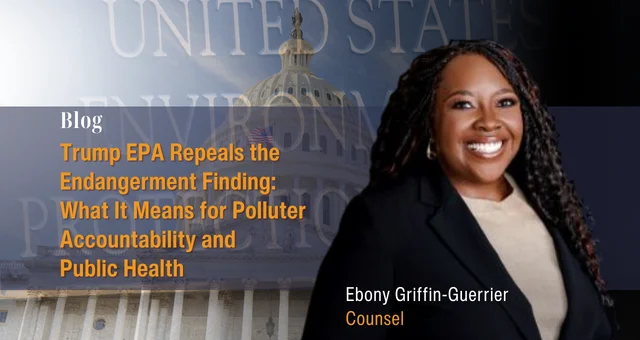
Trump EPA Repeals the Endangerment Finding: What It Means for Polluter Accountability and Public Health
On February 12, 2026, the Trump administration finalized one of the most damaging environmental policy reversals in recent history. Environmental Protection Agency (EPA) Administrator Lee Zeldin announced the formal revocation of the 2009 Endangerment Finding, the scientific and legal foundation that has enabled the federal government to regulate greenhouse gas emissions for the last 17 years.
This decision strips away the EPA's primary tool for addressing climate pollution from vehicles, power plants, and industrial facilities at a moment when regulation is urgently needed. It undermines decades of established science and directly contradicts the Supreme Court's 2007 ruling that greenhouse gases are air pollutants subject to Clean Air Act regulation. For communities living near major industrial facilities, the repeal means reduced federal oversight of emissions that contribute to air pollution and climate-related disasters.
What the Endangerment Finding Was, And Why It Mattered
The Endangerment Finding established that six greenhouse gases, carbon dioxide, methane, nitrous oxide, hydrofluorocarbons, perfluorocarbons, and sulfur hexafluoride, threaten public health and welfare under the Clean Air Act. This determination followed the Supreme Court's decision in Massachusetts v. EPA, which directed the EPA to decide whether greenhouse gases endanger public health.
The Obama-era EPA made that determination in 2009 based on extensive scientific evidence. In the 17 years since, that evidence has only grown stronger; we've experienced record-breaking temperatures, more frequent billion-dollar climate disasters, and devastating wildfires across the country. Yet the Trump administration has chosen to eliminate this finding, arguing that the Clean Air Act does not provide statutory authority for such regulation and dismissing climate concerns as regulatory overreach.
With the Endangerment Finding revoked, the EPA has already begun rolling back vehicle emissions standards. Power plant regulations under Clean Air Act Section 111 are likely next, along with greenhouse gas permitting requirements for major industrial sources. The administration claims this will save consumers money and restore regulatory balance. In reality, it is an abandonment of the EPA's core mission to protect public health and the environment.
The repeal will disproportionately harm low-income communities and communities of color, which are more likely to be located near major industrial facilities and already bear the heaviest burden of air pollution. These communities face compounding risks: not only do they experience higher rates of asthma and respiratory disease from day-to-day emissions, but they also face intensified climate impacts like urban heat islands, flooding, and extreme weather events that the greenhouse gases from nearby facilities directly contribute to. Without federal accountability for these emissions, the gap between polluter profits and community health costs will only widen.
Implications for Environmental Litigation
For environmental attorneys, the repeal creates significant new challenges. Clean Air Act citizen suits targeting greenhouse gas emissions, a tool that communities have long used to challenge industrial pollution, now face an uncertain legal foundation. Without the Endangerment Finding, the basis for challenging facilities' carbon dioxide, methane, and other greenhouse gas releases has been substantially weakened.
This affects potential accountability for major industrial polluters: oil and gas facilities, coal and gas-fired power plants, refineries, cement and steel manufacturers, large agricultural operations, and now data centers running fossil fuel backup generation. These facilities may now increase their greenhouse gas emissions without the federal oversight that existed under the Endangerment Finding.
The impact on common law claims is more limited. Cases that rely on environmental permit violations to establish negligence, such as our ongoing litigation against Drax in Mississippi, where a wood pellet plant has violated its air pollution permit every year since opening operations, can still proceed where documented violations of existing permits exist. However, citizen suits specifically targeting greenhouse gas pollution face substantial new obstacles.
A Critical Exception: Co-Pollutant Claims Remain Viable
While the Endangerment Finding repeal is a devastating blow, it does not eliminate every avenue for holding polluters accountable. There is a critical exception that preserves pathways for justice: criteria pollutants.
Nitrogen oxides, sulfur oxides, and particulate matter have independent regulatory foundations that this repeal does not touch. And critically, facilities that release greenhouse gases almost invariably release these harmful co-pollutants simultaneously. When a coal-fired power plant burns fuel, when an oil refinery processes crude, when a cement kiln operates, they don't just emit carbon dioxide. They also release nitrogen dioxide, sulfur dioxide, and fine particulate matter, pollutants that cause asthma, COPD, heart disease, and premature death.
These emissions remain subject to Clean Air Act regulation and enforcement. Communities can still pursue legal action based on violations of criteria pollutant standards, even as the federal government abandons its responsibility to regulate greenhouse gases.
This means the strategy for environmental litigation must evolve. Rather than relying solely on greenhouse gas regulations that the Trump EPA has destroyed, we must center cases on the immediate, localized health harms caused by criteria pollutants and air toxics: harms that are undeniable, measurable, and devastating to the communities living near industrial facilities.
The Legal Battle Ahead
Environmental organizations have already announced their intention to challenge this repeal in federal court, arguing that the EPA is abandoning its statutory obligation to protect public health and that the scientific evidence supporting the endangerment finding has only strengthened since 2009.
These legal battles will likely take years to resolve. Nevertheless, their outcome will shape environmental law for decades to come.
At Singleton Schreiber, we remain committed to representing communities harmed by industrial pollution and corporate negligence. Even as federal protections are rolled back, we will continue pursuing cases based on permit violations, co-pollutant claims, state environmental laws, and common law principles to protect communities’ right to clean air and safe environments.
The Trump administration’s decision to revoke the Endangerment Finding shifts federal policy, but it does not eliminate accountability. Communities continue to experience the real health impacts of industrial emissions, and environmental justice cannot depend solely on changing regulatory priorities.
If you or your community has been affected by industrial pollution, whether from greenhouse gases, criteria pollutants, or toxic emissions, contact Singleton Schreiber to learn about your legal rights and options. The regulatory landscape may be changing, but our commitment to corporate accountability remains steadfast
 Counsel
Ebony H. Griffin-Guerrier is Counsel at Singleton Schreiber LLP and Co-Director of the firm's Impact Litigation & Policy group, where she leads legal strategy, policy advocacy, and community engagement across a broad range of ...
