
Overview
Insurance Recovery & Bad Faith Attorneys Fighting for Policyholders
Insurance Claim Lawyers for Denied, Delayed, Underpaid, and Wrongfully Handled Claims
Has your insurance company denied a valid claim, delayed payment, offered a lowball settlement, or failed to fairly investigate your homeowners, property, wildfire, or commercial loss? You may have rights as a policyholder when an insurer does not honor the coverage promised by the policy. Working with an experienced bad faith insurance attorney or insurance bad faith lawyer can help you understand the insurer's position, challenge improper claim handling, and pursue insurance benefits and other compensation that may be available under the policy and governing law.
Singleton Schreiber represents homeowners, property owners, businesses, and other policyholders in insurance recovery and bad faith disputes. Our attorneys take on powerful insurance companies in matters involving denied insurance claims, delayed payments, underpaid losses, fire and wildfire damage, smoke and ash contamination, rebuilding disputes, Additional Living Expenses, business interruption, and other first-party insurance claims.
Insurance recovery focuses on obtaining benefits owed under an insurance policy. Insurance bad faith can involve potentially unreasonable claim handling, including wrongful denial, unjustified delay, inadequate investigation, misrepresentation of policy terms, or refusal to pay covered benefits without a reasonable basis. An experienced insurance claim attorney or property insurance attorney can review the policy, loss evidence, insurer investigation, coverage letters, estimates, and payment history to evaluate the dispute.
If you believe an insurance company is treating your claim unfairly, preserve the complete policy and endorsements, claim correspondence, denial or coverage letters, photographs, estimates, inspection and testing reports, receipts, payment records, and a timeline of important communications and claim decisions.

What Does Bad Faith Mean in Insurance?
In the context of insurance, bad faith refers to an insurance company’s failure to fulfill its obligations to policyholders. Insurance companies are legally required to act in good faith, meaning they must treat policyholders fairly and handle claims honestly and diligently.
Bad faith can take many forms, including denying valid insurance claims, unreasonably delaying payment, underpaying a covered loss, misrepresenting policy terms, or failing to properly investigate a claim. For homeowners dealing with serious property damage, these practices can create additional financial and emotional hardship at an already difficult time.
Signs an Insurance Company May Be Acting in Bad Faith
- Wrongful claim denial
- Unreasonable claim delays
- Lowball settlements or underpayment
- Misrepresenting policy terms
- Failure to properly investigate a claim
- Biased or flawed third-party inspections
A bad faith insurance attorney can review the circumstances surrounding your claim and help you understand your options.
Denied Insurance Claims
A denial letter does not necessarily end the claim. Coverage disputes can turn on exclusions, cause of loss, policy conditions, scope, or the insurer's investigation. Review the denial against the complete policy and preserve the evidence supporting coverage.
Delayed Insurance Claims
Complex losses can take time to investigate, but policyholders should be able to understand what remains outstanding and why. Repeated requests for the same documents, unexplained inactivity, frequent adjuster changes, or failure to issue undisputed benefits can justify closer review. Keep a dated claim timeline and preserve proof of every submission and follow-up.
Underpaid and Lowball Insurance Claims
An insurer may accept coverage yet still dispute the amount owed. Underpayment disputes can involve repair scope, labor and material pricing, depreciation, code upgrades, contents valuation, smoke remediation, rebuilding costs, or other covered benefits. Compare the insurer's estimate with contractor bids, expert reports, inventories, and the policy before accepting a low payment as final.
Homeowners and Property Insurance Claim Disputes
Homeowners rely on their insurance coverage to help repair, rebuild, and recover after a serious property loss. When a homeowners insurance claim is denied, delayed, or underpaid, the financial consequences can make an already difficult situation even worse.
Our insurance recovery attorneys represent policyholders in disputes involving:
- Denied homeowners insurance claims
- Delayed homeowners insurance claims
- Underpaid or lowball property insurance claims
- Fire and wildfire insurance claims
- Smoke and ash damage claims
- Disputes over repair and rebuilding costs
- Additional living expense claims
- Personal property and contents claims
- Inadequate or disputed property damage investigations
If your insurance company is refusing to fairly pay a homeowners or property insurance claim, an experienced insurance claim attorney can review your policy, the insurer’s handling of the claim, and the options available to you.
Wildfire, Fire, Smoke & Ash Insurance Claims
Wildfire and fire losses can involve structural damage, smoke and ash contamination, personal property, debris removal, rebuilding costs, and Additional Living Expenses. A home or business does not need to burn to the ground for smoke, soot, ash, or HVAC contamination to create a serious property claim. Disputes may involve testing methodology, cleaning versus replacement, remediation scope, habitability, and the insurer's investigation.
Commercial Property & Business Interruption Claims
Businesses can face both direct property damage and time-element losses after a fire, wildfire, or other covered event. Commercial disputes may involve business income, extra expense, period of restoration, smoke contamination, inventory, equipment, or insurer valuation. Significant business interruption claims often require close coordination between the policy language, financial records, property evidence, and the claim timeline.
What an Insurance Bad Faith Attorney Can Do
When you are involved in a homeowners, property, or other insurance dispute and believe you are not being treated fairly, an experienced insurance lawyer can evaluate your claim and help determine the appropriate course of action.
Examples of situations where you should consider speaking with an insurance attorney include:
1. When your claim is denied.
If you believe your homeowners, property, fire, or other insurance claim was wrongfully denied, you should consider consulting an insurance attorney. Insurance policies and applicable laws may impose deadlines for certain actions, appeals, or lawsuits, making it important to understand your options.
2. When payment is unreasonably delayed.
If you have provided the information requested by your insurer but your insurance company continues to delay investigating or paying your claim, an attorney can evaluate whether the delay may be unreasonable.
3. When your claim is underpaid.
If the insurance company’s payment or estimate does not adequately address your covered property damage, rebuilding costs, smoke or ash damage, personal property, or other losses, an insurance attorney can review the claim and coverage.
4. When you are accused of fraud or causing the loss.
If your insurance company accuses you of insurance fraud or suggests that you caused or contributed to the loss, your insurance claim and other interests may be at risk. Seeking advice from a qualified attorney can help you understand and protect your rights.
5. When your insurance company requests a formal examination.
Many insurance policies allow the insurer to take a policyholder’s statement under oath during an investigation, often referred to as an examination under oath. If your insurer requests one, you should consider consulting an experienced insurance attorney.
6. When your insurance company hires a lawyer.
If your insurance company has retained an attorney in connection with your claim, you may want your own attorney protecting your interests and advising you throughout the process.
7. When you are not getting straight answers.
If you are confused by your insurance company’s responses, have been transferred between multiple adjusters, are repeatedly being asked for the same information, or cannot get clear answers about the status of your claim, an insurance attorney can evaluate the situation and help you understand your options.
What Recovery May Be Available?
Depending on the policy, loss, state law, and facts, a policyholder may seek unpaid policy benefits and other remedies that are legally available. The recoverable amounts and legal theories vary significantly, so the claim should be evaluated under the actual policy and governing law rather than a generic damages formula.
Why Policyholders Choose Singleton Schreiber
Singleton Schreiber represents plaintiffs and policyholders in high-stakes disputes with insurers and other powerful defendants.
Documents You Should Have Available
If you believe our experienced insurance recovery and bad faith attorneys can help you, please contact us to schedule a free evaluation of your case. Providing as much of the following information as possible can help our attorneys evaluate your claim:
- The facts and circumstances of the incident or property loss giving rise to the claim
- Copies of all relevant insurance policies
- Copies of any police, fire, or other incident-related reports
- Your insurance company’s claim denial or coverage letters
- Estimates, repair bids, inspection reports, testing reports, or damage assessments
- Communications with your insurance company or adjusters
- Records or documents relating to the loss
- Documentation of additional living expenses, temporary housing, or other out-of-pocket costs, when applicable
- Personal property or contents inventories, when applicable
Speak With an Insurance Recovery & Bad Faith Attorney
If your homeowners or property insurance claim has been denied, delayed, underpaid, or unfairly handled, you do not have to navigate the dispute alone.
Singleton Schreiber’s insurance recovery and bad faith attorneys help policyholders understand their rights, evaluate disputed insurance claims, and hold insurance companies accountable when they fail to honor their obligations.
Contact Singleton Schreiber to schedule a free evaluation of your case.
Frequently Asked Questions
What is insurance recovery?
Insurance recovery is the process of pursuing benefits available under an insurance policy after a covered loss, including resolving disputes over coverage, valuation, scope, timing, and payment.
What is insurance bad faith?
Insurance bad faith generally concerns potentially unreasonable claim handling, such as wrongful denial, unjustified delay, inadequate investigation, misrepresentation of coverage, or unreasonable withholding of benefits.
What types of insurance claims can lead to bad faith disputes?
Disputes can arise from homeowners, property, fire, wildfire, smoke and ash, business interruption, life, casualty, auto, health, and other insurance claims depending on the policy and circumstances.
Does a denied claim automatically mean the insurer acted in bad faith?
No. A claim can be denied for a legitimate coverage reason. The legal analysis depends on the policy, facts, investigation, insurer reasoning, and applicable law.
What documents should I keep for an insurance dispute?
Keep the complete policy, coverage letters, estimates, photographs, reports, inventories, receipts, payment records, communications, and a dated claim timeline.
What are common signs of insurance bad faith?
Potential warning signs can include an inadequate investigation, unexplained delay, repeated requests for information already supplied, shifting reasons for denial, misrepresentation of policy terms, or refusal to address material evidence. None of these facts automatically proves bad faith; the full claim record and governing law matter.
Can I challenge a lowball insurance settlement?
Yes. If the insurer's estimate or payment appears too low, compare its scope and pricing with contractor estimates, expert reports, inventories, and the policy. A material valuation dispute may involve additional documentation, negotiation, appraisal where applicable, or legal review.
What can an insurance bad faith attorney do?
Counsel can review the policy and claim history, identify disputed benefits, organize evidence, evaluate the insurer’s investigation and communications, address coverage or valuation issues, and advise on available claim or legal remedies.
Does Singleton Schreiber handle wildfire and property insurance disputes?
Singleton Schreiber represents policyholders in insurance recovery and bad faith disputes involving homeowners and property claims, fire and wildfire losses, smoke and ash contamination, rebuilding, Additional Living Expenses, and related first-party insurance issues.
Case Results
News & Insights
News
 |Media Mention, KHQ-TV
Partner Rich Barker speaks with KHQ-TV about helping Spokane fire victims navigate FEMA and insurance claims.
 |Media Mention, The Spokesman-Review
Partner Vanessa Waldref speaks with The Spokesman-Review about insurance claim documentation and recovery resources for Spokane fire survivors.
 |Media Mention, LA Daily News
Partner Michelle Meyers is working pro bono to give Eaton and Palisades fire survivors a direct legal voice in California's enforcement action against State Farm.
 |Media Mention, Straight Arrow News
Partner Michelle Meyers represents more than 10,000 wildfire survivors petitioning to join California's enforcement case against State Farm over ongoing claims disputes blocking the ...
 |Media Mention, SFGATE
Michelle Meyers of Singleton Schreiber represents wildfire survivors petitioning to join California's investigation into State Farm's claims handling following the 2025 Eaton and ...
 |Media Mention, Insurance Business
Partner Michelle Meyers joined Consumer Watchdog and wildfire survivors as EFSN petitioned for formal standing in California's enforcement case against State Farm.
 |Media Mention, Los Angeles Times
Michelle Meyers of Singleton Schreiber represents wildfire survivors petitioning to join California's enforcement action against State Farm, seeking tougher penalties and a systematic ...
 |Media Mention, Palisadian Post
Partner Michelle Meyers is representing wildfire survivors seeking formal legal standing in California's enforcement proceeding against State Farm over claims mishandling.
 |Media Mention, PR Newswire
Partner Michelle Meyers represents wildfire survivors petitioning for formal standing in California's enforcement proceeding against State Farm over documented mishandling of claims.
 |Media Mention, Pasadena Stars News | The Orange County Register
Partner Michelle Meyers represents Eaton fire victims in class-action lawsuits disputing insurer smoke damage coverage following the 2025 Los Angeles wildfires.
 |Media Mention, Pasadena Stars News | Los Angeles Daily News
Partner Michelle Meyers is counsel for Eaton fire victims in pending class-action lawsuits challenging insurer denials of smoke damage claims arising from the 2025 Los Angeles wildfires.
 |Media Mention, Pasadena Star News
Singleton Schreiber Partner Michelle Meyers litigates Eaton fire smoke damage claims as California courts and legislators work toward enforceable testing and remediation standards.
 |Media Mention, Pasadena Now
Partner Michelle Meyers discusses proposed California legislation designed to help families better understand when their homes are truly safe to return to after a wildfire by creating ...
 |Media Mention, CalMatters
Michelle Meyers examines California wildfire smoke remediation standards, insurance claim disputes, and proposed legislation impacting fire survivors and homeowner safety.
 |Media Mention, Pasadena Now
Michelle Meyers represents homeowners challenging post-Eaton Fire contamination testing that allegedly influenced insurance decisions on smoke-damage remediation.
 |Media Mention, Altadena Now
Michelle Meyers represents Altadena homeowners in a class-action lawsuit alleging faulty smoke-damage testing after the Eaton Fire.
 |Media Mention, Daily Journal
Singleton Schreiber Partner Michelle Meyers filed a class action alleging Farmers Insurance relied on inadequate testing to deny wildfire smoke damage claims.
 |Media Mention, Law.com
Partner Michelle Meyers of Singleton Schreiber represents homeowners in novel class actions alleging that insurers and hygiene vendors conducted inadequate wildfire‑contamination ...
 |Media Mention, Las Vegas Optic
Gerald Singleton, Managing Partner at Singleton Schreiber, provided updates to Hermits Peak/Calf Canyon Fire victims during a community meeting covered by the Las Vegas Optic. He ...
 |Media Mention, The Columbus Dispatch
Singleton Schreiber was recently featured in The Columbus Dispatch in an article titled “California wildfire victims sue Nationwide over withheld insurance payments.” In the ...
 |Media Mention, Altadena Now
Michelle Meyers, Partner at Singleton Schreiber, was recently featured in Altadena Now in an article titled “Eaton Fire Survivors Continue to Target Multiple Insurers Over Alleged Bad ...
 |Media Mention, PASADENA NOW
Singleton Schreiber LLP filed a lawsuit against Nationwide on behalf of the Greer family, alleging that the company engaged in bad faith insurance practices following the Eaton Fire. The ...
 |Media Mention, Bloomberg Law
Michelle Meyers, Partner at Singleton Schreiber in Sacramento and San Diego, recently wrote "California Pays for Insurance Struggles and FAIR Plan Dependence" which was published by ...
 |Media Mention, Sacramento Business Journal
Michelle Meyers, Partner at Singleton Schreiber in Sacramento, was recently featured by the Sacramento Business Journal in their "People on the Move in Sacramento" section.
The section ...
 |Media Mention, The Cool Down
Michelle Meyers, Counsel at Singleton Schreiber, was recently featured in The Cool Down for her insights on questionable insurance nonrenewals affecting California homeowners. Insurers ...
 |Media Mention, ABC News
Michelle Meyers, Counsel at Singleton Schreiber in Sacramento, was recently featured by ABC News in their segment, "CA Homeowners Impacted by Wildfires Face Uncertain Future Amid ...
 |Media Mention, The San Francisco Standard
Michelle Meyers, Counsel with Singleton Schreiber, was featured in The San Francisco Standard article, "Grainy Photos of Their Roofs Cost Them Their Insurance. Now Homeowners Are ...
 |Media Mention, KFI AM 640
Letitia S. Johnson, Managing Partner of Singleton Schreiber's Southeastern Region, appeared on ‘Later, with Mo’Kelly’ to discuss the firm’s Eaton and Hurst Fire lawsuits. She ...
 |Media Mention, KCRA-TV
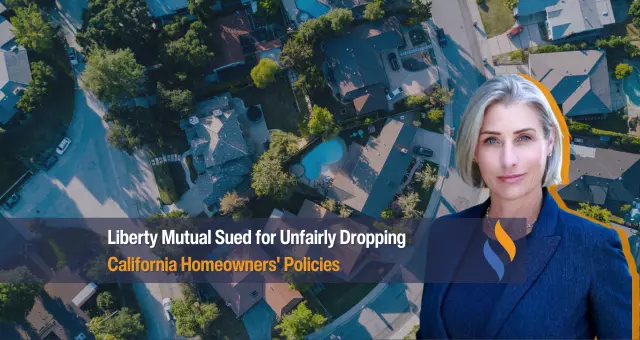
Michelle Meyers, Counsel with Singleton Schreiber, was featured in a recent KCRA-TV (Sacramento, CA) news segment discussing a class action lawsuit against Liberty Mutual. The lawsuit ...
 |Media Mention, Daily Mail
Michelle Meyers, Counsel of Singleton Schreiber, has been working on a class-action suit against a major home-insurer. This class-action was recently reported on by Daily Mail, "Liberty ...
 |Media Mention
In a recent article, "Liberty Mutual Declined to Renew This Southern California Homeowner’s Policy. Now She’s Suing," featured in the Los Angeles Times, a lawsuit was filed by Maria ...
 |Media Mention, San Francisco Chronicle
Michelle Meyers, Counsel of Singleton Schreiber, was recently featured in a San Francisco Chronicle article titled, "California Homeowner Sues Liberty Mutual, Claims Insurance Dropped ...
 |Media Mention, KCBS Radio
In a recent interview with KCBS Radio, "Higher Premiums, Lower Coverages—California's New Fire Insurance Regulations," Michelle Meyers, Counsel of Singleton Schreiber shared ...
Press Releases

Blog Posts
 |Blog
|BlogAt a time when Californians face increasing risks from wildfires, rising medical costs, and ongoing litigation, the state’s largest insurer, State Farm, is now withdrawing critical ...
- |Blog
Homeowner’s insurance is a vital safety net for Californians, especially in areas prone to natural disasters such as wildfires. Yet, recent trends indicate that obtaining adequate ...
- |Blog
When you purchase insurance, it helps to give you peace of mind and, most importantly, protect you when the worst-case scenario occurs. When you get in a car accident in Albuquerque, you expect ...
- |Blog
Oftentimes, purchasing an insurance policy gives you peace of mind and provides some protection should the worst-case scenario become a reality. This gives you a sense of safety should you ...

Events
![Spokane Complex Fire Recovery In Person Town Hall [08/21/2026)]](/assets/images-t1791406448/4222.webp) |Event, Spokane, WA
|Event, Spokane, WA |Webinar, Virtual
 |Speaking Engagement, New Orleans
 |Speaking Engagement, Conrad Punta de Mita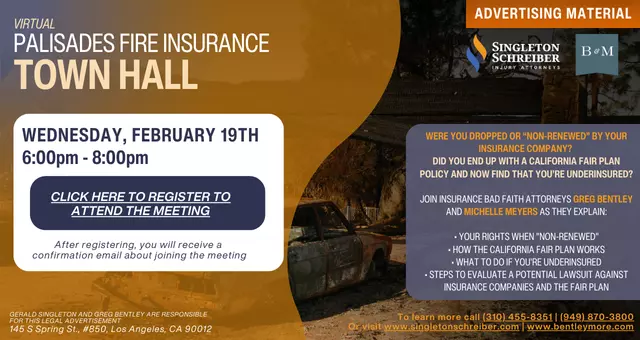
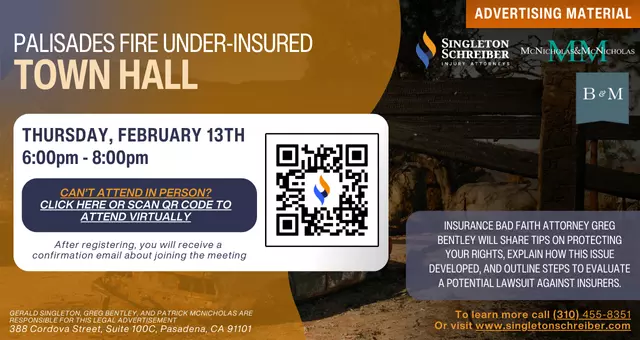
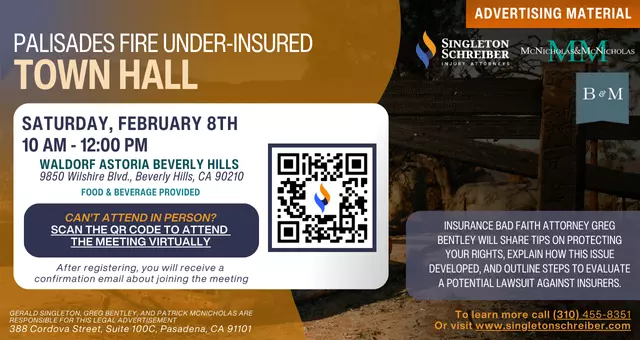 |Event, Waldorf Astoria Beverly Hills
Recommended Internal Links
- Homeowners Insurance Bad Faith & Property Insurance Claims
- Denied, Delayed & Underpaid Homeowners Insurance Claims
- Smoke & Ash Damage Insurance Claims After a Wildfire
- What to Do When Your Insurance Claim Is Denied
- Insurance Company Taking Too Long to Pay?
- Additional Living Expenses After a Wildfire
- Underinsured After a Wildfire
- Business Interruption Insurance Claims
